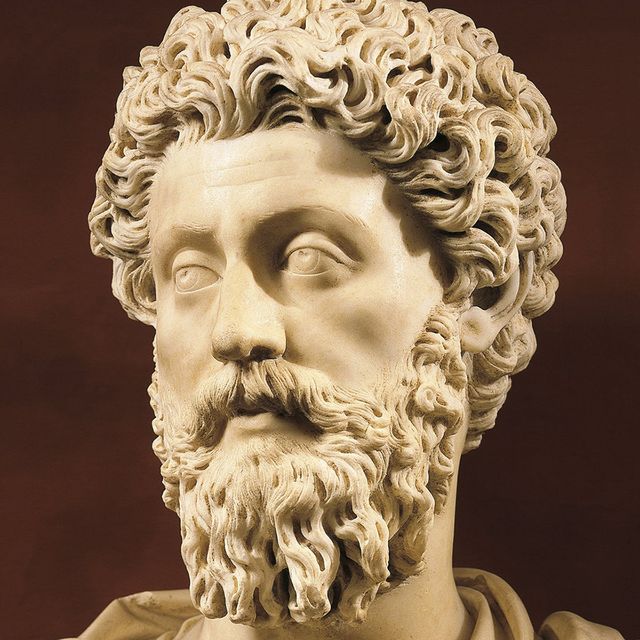
Marcus Aurelius was a Roman emperor and Stoic philosopher whose life sits at one of history’s most charged intersections: absolute power and relentless self-examination. Ruling in the second century CE, he is remembered not only as a head of state during years of military pressure and internal strain, but also as the author of Meditations, a private notebook of ethical reminders that became one of the most enduring texts of ancient philosophy.
He matters because he embodies a paradox that continues to fascinate readers and political thinkers: a man entrusted with an empire who wrote, not propaganda or triumphal memoir, but a record of inner discipline—an attempt to live up to an ideal of justice, humility, and reason while surrounded by flattery, violence, and the burdens of command. In cultural memory, Marcus Aurelius has become a symbol of “the philosopher-king,” a concept older than Rome and still alive in modern leadership mythology. Yet his legacy is not just an idealized portrait. It is also a case study in the constraints of virtue within institutions built on hierarchy, conquest, and slavery—tensions that make his writings compelling rather than comfortable.
Early Life & Influences
Marcus Aurelius was born into a prominent Roman family and raised within the elite networks that produced imperial administrators and senators. His early life unfolded in a world where lineage, patronage, and education shaped destiny, and where Rome’s ruling class cultivated a shared language of duty—service to the state as a moral identity.
From a young age he was drawn to philosophy, particularly Stoicism, the Greco-Roman tradition that taught the pursuit of virtue through reason, self-control, and acceptance of what cannot be changed. Stoicism was not merely an abstract school in his world; it was a practical ethical system used by statesmen and intellectuals to think about fate, responsibility, anger, fear, and the temptations of power. Marcus’ later writing shows that he did not treat philosophy as ornamentation. He treated it as a tool for survival—an inner regimen designed to keep a ruler from being ruled by his impulses.
His influences also included the Roman moral tradition of pietas—a commitment to duty toward family, community, and the gods—and the example of older statesmen who framed leadership as service rather than self-display. These ideas did not eliminate imperial violence, but they created a vocabulary with which Marcus judged himself.
Childhood Details
The publicly known outline of Marcus’ childhood is shaped by Roman political realities rather than personal anecdote. He lost his father while still young and was raised under the guardianship and patronage structures typical of the aristocracy. What stands out is not the domestic detail—much of which is hard to reconstruct with certainty—but the early recognition of his promise by those near the imperial center.
Even as a child, Marcus was positioned within Rome’s system of grooming future leaders: public visibility, careful training, and association with powerful benefactors. His later emphasis on modesty and the dangers of ego can be read as a response to that upbringing. He learned early what it meant to be watched, praised, and prepared for roles he did not fully control.
Family Details
Marcus’ family life is documented in broad, historically secure terms. He married Faustina the Younger, and they had multiple children. One of their sons, Commodus, would later become emperor. Marcus’ relationship to family was not merely personal; in Rome, it was political. Marriage alliances, heirs, and household reputation were state concerns, braided tightly into legitimacy.
These family facts matter because they complicate the popular image of Marcus as pure philosopher. He was also a dynast, operating within a system that demanded continuity. His decision to elevate Commodus as successor—rather than return to a purely adoptive model of succession associated with some earlier emperors—has been debated by historians. It is a reminder that even a ruler committed to virtue made choices shaped by tradition, pressure, and uncertainty.
Formative Training / Education
Marcus received the elite education expected of a Roman noble: training in rhetoric, law, literature, and philosophy. He studied with prominent teachers, including figures associated with Stoicism. Among the best-known is Junius Rusticus, often cited as a key Stoic influence who pushed Marcus toward a more rigorous moral seriousness. He also learned from rhetoricians such as Fronto, whose correspondence with Marcus survives and offers a window into his intellectual formation and the daily texture of elite education.
This education mattered because Roman leadership was, in part, a performance: the ability to speak in the Senate, to write and respond to petitions, to frame policy in persuasive language. Marcus mastered that outward craft, but his philosophical writings show a parallel inward training—learning how to govern himself when outward authority was absolute.
Early Career
Before becoming emperor, Marcus was brought into imperial service through a sequence of appointments and honors typical for a designated heir. He held high office and was gradually introduced to the responsibilities of governance, law, and administration.
A decisive turning point in his early career was adoption into the imperial succession plan orchestrated by Emperor Hadrian, who arranged for Antoninus Pius to adopt Marcus (and also Lucius Verus). This adoption was political architecture: it created a line of succession meant to stabilize the empire by selecting heirs for competence and continuity rather than relying only on birthright. Marcus’ path to power was therefore not accidental; it was the result of deliberate institutional design.
Serving under Antoninus Pius, Marcus spent years in apprenticeship to an emperor known for administrative steadiness. This long preparation helped shape Marcus’ sense of rulership as work—patient, procedural, and often unglamorous.
Breakthrough
Marcus became emperor after the death of Antoninus Pius, entering the highest office in the Roman world. One of the defining features of his accession was that he ruled jointly with Lucius Verus for a time—an arrangement that reflected both the adoption plan and the political need to distribute authority.
His “breakthrough” moment, in the sense of his historical identity, was not a single victory or proclamation. It was the convergence of philosophy and power: the instant the man who had practiced ethical self-discipline in private was forced to test it in the open, with armies, borders, epidemics, and court politics pressing constantly on his attention.
Major Works / Career Phases
The Reign: War, Administration, and Pressure at the Borders
Marcus’ reign is often summarized by the challenges that surrounded it. Rome faced serious military conflicts, especially along the northern frontiers, where pressure from various Germanic and other groups demanded prolonged campaigning and strategic attention. These wars consumed years and shaped the lived reality of his rule: the emperor was frequently with the army, managing logistics and morale as much as strategy.
His reign also coincided with a devastating plague—commonly referred to by modern historians as the Antonine Plague—which affected the empire’s population and stability. While ancient sources do not provide modern epidemiological certainty, there is broad agreement that the outbreak had serious consequences. This context matters because it underscores how much of Marcus’ rulership was crisis management, not grand architectural ambition.
Meditations: A Private Text That Became a Public Classic
Marcus’ enduring “work” is Meditations, written in Greek and composed as a series of notes to himself. It was not produced as a polished treatise, and it does not behave like a conventional book meant for publication. Instead, it reads as a discipline: repeated reminders to remain calm, to act justly, to accept mortality, to resist anger and vanity, and to remember that reputation is fleeting.
Its very nature is part of its power. Because it was not written as self-justification, it feels unusually intimate for an ancient ruler. It reveals a mind trying to stay steady under stress—returning again and again to the same themes, as one does when building a habit. This is why Meditations has outlived countless official decrees: it is not a document of what Rome claimed to be, but of what one man struggled to become.
The Succession: Commodus and the Limits of Philosophical Rule
Marcus’ decision to position Commodus as successor is one of the most consequential acts of his reign. Commodus’ later rule has been portrayed by many ancient sources as erratic and harmful, though the details are filtered through political bias and senatorial hostility. Still, the broad arc—stability followed by severe turbulence—is widely accepted.
This phase matters for Marcus’ biography because it complicates simplistic hero narratives. Philosophical clarity does not guarantee political outcomes. A ruler can be conscientious and still leave behind an unstable future. Marcus’ legacy therefore includes not only his ideals but the historical lesson that systems of power can outlast and distort even well-intentioned leadership.
Themes, Style & Craft
Stoicism as Practice, Not Pose
The central theme of Marcus’ philosophical writing is Stoic ethics: virtue as the only true good, the importance of reason, the discipline of desire, and the acceptance of fate. But the distinctive feature of Meditations is its tone. Marcus does not write like a man announcing his enlightenment. He writes like a man warning himself not to fail.
A Style Built on Repetition and Urgency
Meditations is marked by short, forceful entries rather than elaborate arguments. Marcus returns repeatedly to mortality, humility, and the need to act without complaint. The repetition is often what modern readers remember: not because he lacked originality, but because he understood how the mind resists discipline. The text is a training ground. Its craft is the craft of reinforcement.
Ethics Under Power
Perhaps the most important “theme” is the attempt to live ethically inside empire. Marcus urges himself toward justice and empathy while ruling a state that could be brutal. This tension is not resolved in the text; it is held. That is precisely why it continues to provoke interpretation: some readers see him as evidence that power can be tempered by philosophy; others see him as evidence that philosophy can coexist with injustice without dismantling it.
Reception / Adaptations
In antiquity, Marcus was remembered as a relatively respected emperor, and later tradition often grouped him among the “good emperors,” a modern shorthand derived from assessments of stability and governance. Over centuries, Meditations became one of the most widely read philosophical works from the ancient world, influencing religious thinkers, moral philosophers, and modern self-help and leadership literature.
In contemporary culture, Marcus Aurelius appears frequently in discussions of resilience and “stoicism” (sometimes simplified into a mood rather than a philosophy). His writings are quoted, paraphrased, and repackaged in countless formats. This popularity has helped keep Stoicism visible, though it sometimes flattens the tradition into slogans. Even so, the persistence of Meditations across languages and eras is itself a remarkable form of reception: a private notebook turned into a global companion text.
Personal Life / Public Commitments
Marcus’ personal life cannot be separated from public duty; for a Roman emperor, there was no clean boundary. His commitments were the commitments of office: the army, the law, the imperial administration, and the religious and ceremonial roles attached to emperorship.
He is also historically associated with the Roman state’s stance toward certain religious groups during his reign, including episodes of persecution of Christians in parts of the empire. The extent of his personal responsibility is debated by historians, and ancient evidence is complex and regionally variable. Still, the association exists in the historical record and is part of the moral context in which his legacy is judged.
Legacy
Marcus Aurelius endures for a rare reason: he is remembered less for what he built than for what he wrote to himself while trying to hold a world together. For readers, Meditations offers a voice that feels surprisingly modern—anxious about time, skeptical of fame, determined to do good without applause. For philosophers, he represents Stoicism in action, not in seminar form: ethics as daily labor. For political thinkers, he stands as both aspiration and caution: the dream of wise rule, and the evidence that wisdom does not automatically solve the structural problems of empire.
His cultural impact is also tied to the portability of his ideas. In an age of distraction and performance, his insistence on inner integrity remains compelling. Yet his example also invites critique: it asks whether personal virtue is enough when the system itself is built on domination. That unresolved question—how to live well inside flawed structures—is one reason Marcus Aurelius still matters. He is not merely a monument to ancient greatness; he is a continuing argument about power, responsibility, and the strenuous possibility of moral life.